Last updated:
Quick answer (updated November 2026): The biggest new medical technology of 2026 is arriving in three areas: surgical robots, smarter scanners and brain-computer interfaces. Johnson & Johnson’s table-integrated OTTAVA robot received US FDA authorization in July 2026, Medtronic’s Hugo robot gained its first real-time AI tool, and Intuitive’s da Vinci 5 was cleared for cardiac procedures. In imaging, GE HealthCare’s Photonova Spectra photon-counting CT was cleared in March 2026, a portable photon-counting CT for arms and hands was cleared, and bedside MRI keeps improving with AI. The FDA’s list of AI-enabled medical devices has reached 1,614. And three companies — Neuralink, Synchron and Paradromics — are testing brain implants in people.
Hospitals are changing faster than at any time in decades. This guide explains, in plain English, seven machines that matter in 2026: what each one does, what is officially approved, and what it means for patients. It is a technology explainer, not medical advice.
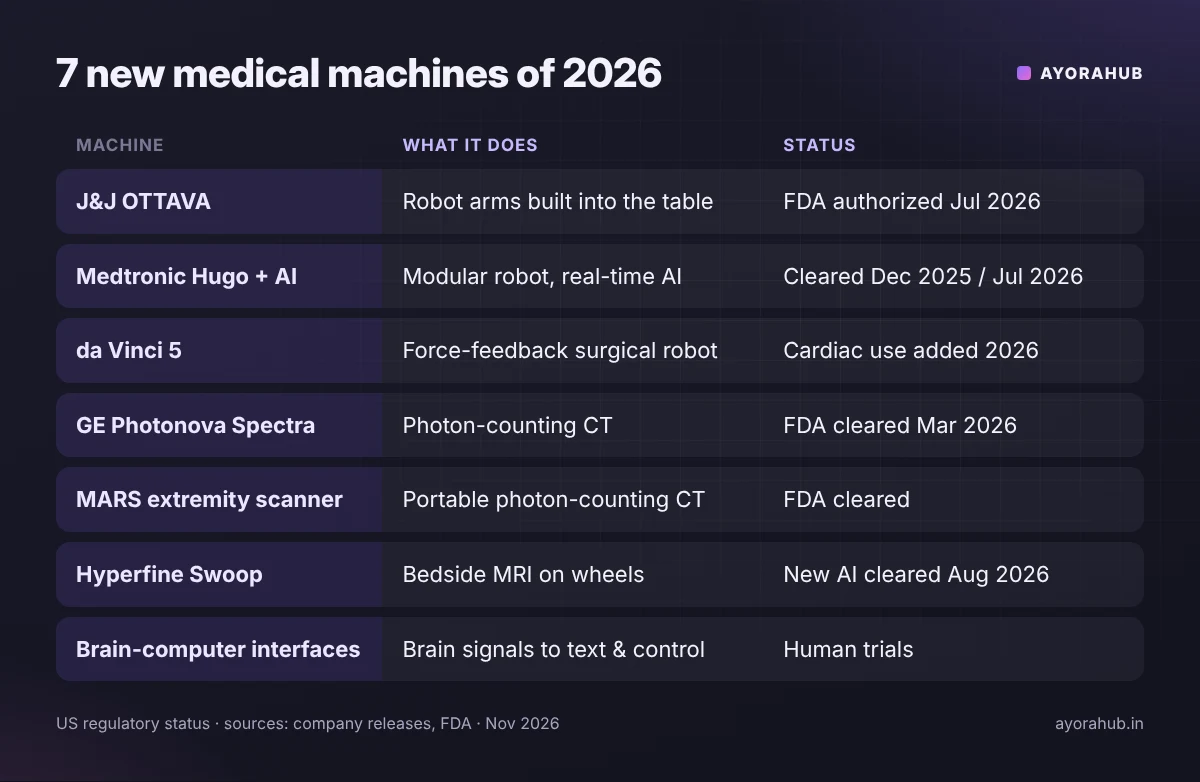
7 new medical machines of 2026 at a glance
| # | Machine | What it does | Status |
|---|---|---|---|
| 1 | J&J OTTAVA surgical robot | Robot arms built into the operating table | FDA De Novo authorization, July 2026 |
| 2 | Medtronic Hugo + Touch Surgery AI | Modular surgical robot with real-time AI guidance | Hugo cleared Dec 2025 (urology); AI app cleared July 2026 |
| 3 | Intuitive da Vinci 5 | Surgical robot with force feedback | Cleared 2024; cardiac procedures added in 2026 |
| 4 | GE Photonova Spectra | Photon-counting CT scanner | FDA 510(k) clearance, March 2026 |
| 5 | MARS extremity scanner | Portable photon-counting CT for arms and hands | FDA 510(k) clearance |
| 6 | Hyperfine Swoop | Portable MRI that rolls to the bedside | New AI software cleared August 2026 |
| 7 | Brain-computer interfaces | Implants that turn brain signals into text, speech or cursor control | Human trials; none fully approved |
Swipe to see more →
1. OTTAVA: the robot that lives in the operating table
Most surgical robots are large carts parked next to the patient. Johnson & Johnson’s OTTAVA puts the robotic arms inside the operating table. The FDA granted it De Novo authorization in July 2026 for several general-surgery procedures in the upper abdomen, such as gastric bypass, gallbladder removal and appendectomy. J&J says the design takes up 30–50% less space than cart-based systems (a company claim) and plans to start with selected US hospitals.
2. Hugo gets real-time AI
Medtronic’s Hugo robot was cleared by the FDA in December 2025 for urologic surgery, with more specialties expected. In July 2026, Medtronic announced clearance of Instrument Exit Point, its first real-time AI application for robotic surgery, running on the Touch Surgery Aide computing platform. It is a sign of where surgery is heading: software that watches the operation and supports the surgeon while it happens.
3. da Vinci 5 moves into heart surgery
Intuitive’s da Vinci is the most widely used surgical robot. Its newest model, da Vinci 5 (cleared in 2024), adds force feedback, so surgeons can sense how hard instruments push on tissue. In 2026 it gained clearance for certain cardiac procedures, including mitral valve repair, and updated force-feedback instruments. Full comparison: surgical robots in 2026.

4. Photon-counting CT: sharper scans
A normal CT scanner turns X-rays into light and then into a signal. A photon-counting CT counts each X-ray photon directly and measures its energy, which can give sharper images and better information about tissue. Siemens Healthineers introduced the first such scanner in 2021. In March 2026, GE HealthCare’s Photonova Spectra — built on a “Deep Silicon” detector — received FDA clearance. More: photon-counting CT explained.
5. A portable photon-counting CT
New Zealand’s MARS Bioimaging received FDA clearance for a compact photon-counting scanner for the upper limbs (hand, wrist, elbow). It is designed for clinics, sports medicine and urgent care, bringing advanced imaging closer to where injuries are treated.
6. MRI that comes to the patient
Hyperfine’s Swoop is a low-field MRI on wheels. It does not need a shielded room, so it can scan a patient’s brain in intensive care or the emergency department. A next-generation system was cleared in 2025; in August 2026 the FDA cleared new Optive AI software that improves image quality, and the system gained European and UK approval in April 2026.
7. Brain-computer interfaces
Brain-computer interfaces (BCIs) read brain activity so people with paralysis can control a computer or communicate. In 2026, Paradromics completed its first implant in an FDA-approved study, Neuralink continued its feasibility trials, and Synchron — whose device is inserted through a blood vessel — is preparing a larger pivotal trial. No BCI has full FDA approval yet. More: brain-computer interfaces in 2026.
The engine behind it all: AI
The FDA’s public list now names 1,614 AI-enabled medical devices, about three-quarters of them in radiology. See AI medical devices: what the FDA has authorized.
What this means for patients
- “FDA cleared” is not the same as “better for you”. Clearance means a device met regulatory requirements; your doctor decides what suits your case.
- New machines reach big hospitals first and spread slowly; availability and cost vary by country.
- The surgeon and the team still matter most. A robot is a tool.
- Ask questions: how many procedures has the team done with this system, and what are the alternatives?
Tools we recommend · Affiliate links: we may earn a commission if you sign up, at no extra cost to you.


Frequently Asked Questions
What is the latest technology in medical science in 2026?
New surgical robots such as OTTAVA and Hugo, photon-counting CT scanners, portable MRI, AI-enabled imaging devices and brain-computer interfaces in clinical trials.
Which new surgical robot was approved in 2026?
Johnson & Johnson’s OTTAVA received FDA De Novo authorization in July 2026 for general-surgery procedures.
What is a photon-counting CT scanner?
A CT scanner that counts individual X-ray photons and measures their energy, which can produce sharper, more detailed images than conventional CT.
Are brain chips approved for patients?
No. Brain-computer interfaces from Neuralink, Synchron and Paradromics are in clinical trials; none has full FDA approval.
How many AI medical devices has the FDA authorized?
1,614 on the FDA’s list as updated in September 2026, about 76% of them in radiology.
Is robotic surgery done by a robot alone?
No. A trained surgeon controls the robot at all times.
Beyond the hospital: the same AI advances are now teaching general-purpose humanoid robots to learn tasks from human demonstrations — see Nvidia GR00T 2 explained.
Conclusion
Medical technology in 2026 is moving from single breakthrough machines to connected systems: robots, scanners and software that share data and use AI. The promise is real, but so is the need for evidence and skilled people. Follow each topic in our detailed guides linked above.
Medical disclaimer
This article explains technology for general information only. It is not medical advice and does not recommend any device, test or treatment. Always consult a qualified doctor about your own health.
How we researched this
We used company press releases and regulatory filings, FDA information and coverage by medical-technology trade publications, checked in November 2026. Performance claims by manufacturers are identified as such. Regulatory status is for the United States unless stated and can change; availability differs by country.
Sources
- Johnson & Johnson – FDA market authorization for OTTAVA
- Medtronic – Touch Surgery Aide and real-time AI
- GE HealthCare – Photonova Spectra FDA clearance
- Radiology Business – FDA clears portable photon-counting CT
- Hyperfine – FDA clearance of Optive AI software
- Paradromics – First Connexus BCI implantation
- The Imaging Wire – FDA AI device list update