Last updated:
Quick answer (updated 13 November 2026): Neuralink is Elon Musk’s brain–computer interface (BCI) company. Its implant, called the N1 (“the Link”), records brain signals through ultra-thin threads placed by a surgical robot. It is used in three projects:
- Telepathy lets people with paralysis control a computer or phone by thought. It is in human trials, with 21 participants reported in January 2026.
- Blindsight aims to restore basic vision. It was awaiting regulatory approval for human trials, and no human study was listed in the US registry as of early November 2026.
- VOICE is a trial to restore speech, announced in January 2026.
No peer-reviewed human results had been published as of August 2026.
Neuralink’s videos of patients playing chess or video games by thought went viral. But how does the technology work, what has really been proven, and where are trials running worldwide? Here is a clear, evidence-based guide.
How does Neuralink work?
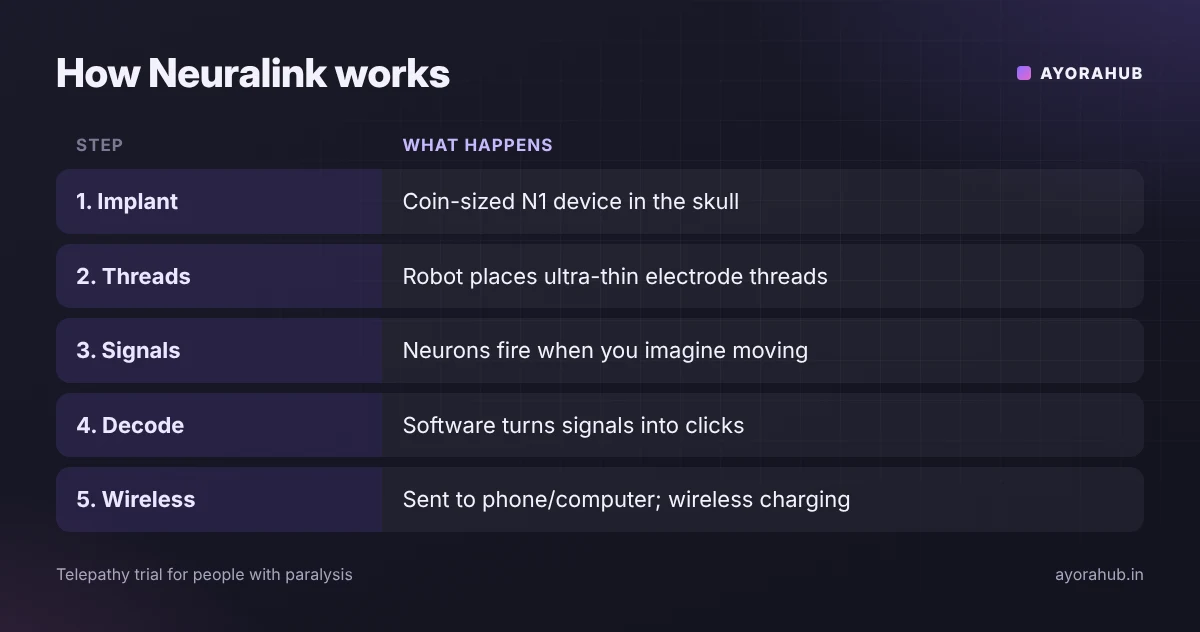
- The implant: a coin-sized, sealed device that sits in a small opening in the skull, flush with the bone and invisible under the skin.
- The threads: dozens of threads, thinner than a hair and carrying many electrodes, are inserted into the brain’s motor area by Neuralink’s surgical robot (R1).
- Reading signals: when the person imagines moving their hand, neurons fire in patterns that the electrodes record.
- Decoding: software turns those patterns into cursor movements and clicks, sent wirelessly to a computer or phone. The battery charges wirelessly.
The idea is not new. Academic BCIs (such as BrainGate) have shown thought-controlled cursors since the 2000s. Neuralink’s contributions are a fully implanted wireless design, a robot for placing the threads, and the aim of turning BCIs into a scalable medical product.
Neuralink products and trials
| Project | Goal | Status (Nov 2026) |
|---|---|---|
| Telepathy | Control a computer or phone by thought (paralysis, ALS) | Human trials; 21 participants reported (Jan 2026); reportedly cleared to expand the motor trial |
| VOICE | Restore speech | Trial announced Jan 2026 |
| Blindsight | Basic vision by stimulating the visual cortex | Animal work; human trial awaiting approval; not on ClinicalTrials.gov (early Nov 2026) |
| Robotic-arm control (CONVOY) | Control an assistive robotic arm | Research study |
Is Blindsight working in humans?
This is where to be careful. In January 2026 Musk said Neuralink was ready for the first Blindsight implant “pending regulatory approval”. One fan website reported in October 2026 that the first blind participant had regained basic vision. We could not confirm this from Neuralink’s own updates or any independent source, and the trial was not registered in the US clinical-trial registry as of early November 2026. Even if it works, early Blindsight vision is expected to be low resolution, like seeing simple shapes and light, not normal sight.
Benefits and risks
- Benefits: independence for people with severe paralysis, faster communication than eye-tracking tools, and a possible future path to restoring speech or vision.
- Risks: brain surgery risks (infection, bleeding); threads can shift, which happened to the first participant and reduced signal before software changes improved it; and the long-term durability is unknown.
- Privacy and ethics: brain data is the most sensitive data there is. Who stores it and how it is used matters.
- Evidence gap: results are shared mostly through company updates and videos, not peer-reviewed papers.
Where are Neuralink trials running?
| Country | Study | Sites (reported) |
|---|---|---|
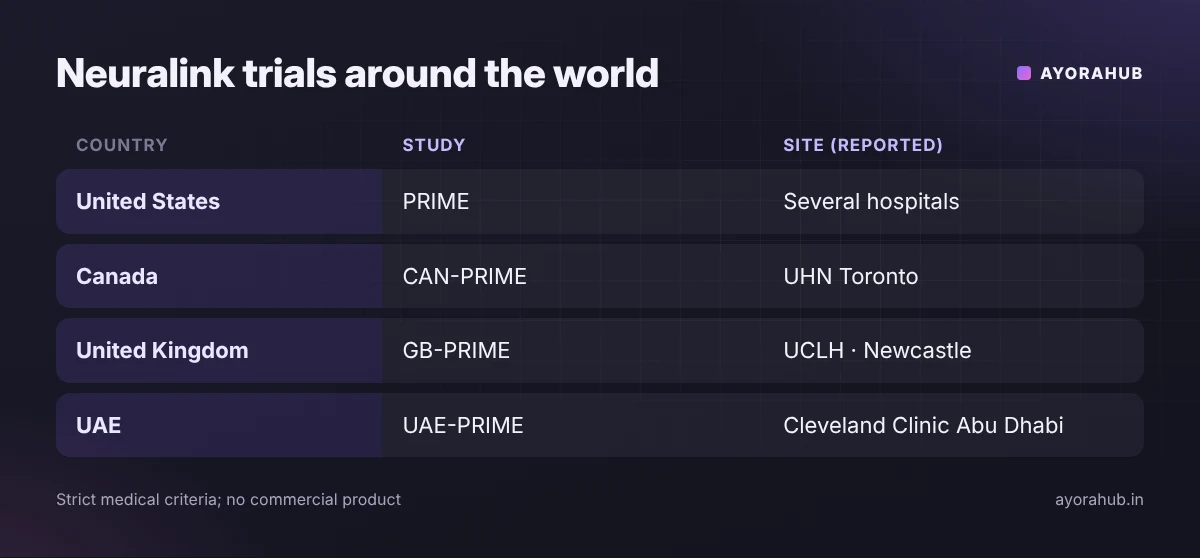
| United States | PRIME and follow-on studies | Several US hospitals |
| Canada | CAN-PRIME (approved by Health Canada, Nov 2024) | University Health Network, Toronto |
| United Kingdom | GB-PRIME (approved by the MHRA) | UCLH (London) and Newcastle upon Tyne Hospitals |
| United Arab Emirates | UAE-PRIME | Cleveland Clinic Abu Dhabi (enrolment unclear) |
Participants must meet strict medical criteria, such as quadriplegia from spinal cord injury or ALS. There is no commercial product or price anywhere, and no trial has been announced in India, Australia or the EU. Be wary of anyone selling Neuralink “appointments” or devices. To apply, use the patient registry on Neuralink’s official website.
Common myths
- “Neuralink can read your thoughts.” It decodes specific motor intentions from one brain area; it does not read general thoughts.
- “It’s available to buy.” It is an experimental medical device in trials.
- “Blindsight cures blindness.” It aims for basic, low-resolution vision and has not been proven in humans.
- “It’s for healthy people.” All current trials are for people with serious medical conditions.
Tools we recommend · Affiliate links: we may earn a commission if you sign up, at no extra cost to you.

Frequently Asked Questions
What is Neuralink used for?
Right now, to let people with paralysis control computers and phones by thought (Telepathy). Speech (VOICE) and vision (Blindsight) projects are in earlier stages.
How many people have a Neuralink implant?
Neuralink reported 21 participants implanted worldwide in its January 2026 update. Some outlets report higher numbers we could not verify.
Has Blindsight been implanted in a human?
Not confirmed. As of early November 2026, no human Blindsight trial was registered, and claims of a first patient were not confirmed by Neuralink’s official updates.
Is Neuralink safe?
It involves brain surgery and is still being tested. Long-term safety is not yet known, and no peer-reviewed human data had been published as of August 2026.
How much does Neuralink cost?
There is no price, because it is not a commercial product. Trial participants do not buy it.
Who founded Neuralink?
Elon Musk co-founded it in 2016 with a team of scientists and engineers. See all Elon Musk companies and technologies.
Conclusion
Neuralink has shown that a fully implanted, wireless BCI can give people with paralysis real digital independence. The bigger promises, restoring vision and speech, are still unproven in humans. Follow Neuralink’s official updates and trial registries rather than viral clips.
How we researched this
We used Neuralink’s January 2026 update as reported by several outlets, reporting on the Canadian, UK and UAE trials, the public US clinical-trial registry status reported in November 2026, and independent coverage, checked on 13 November 2026. We did not include patient numbers or results that we could not trace to Neuralink or a reliable source. This article is for information only and is not medical advice.
Sources
- Neuralink – official website and updates
- XenoSpectrum – Blindsight: no vision trial registered
- Drug Development – Blindsight faces questions over clinical readiness
- TokenPost – Neuralink lists Blindsight as upcoming trial
- eWeek – Neuralink trial in the UK
- Benzinga – Neuralink trial approved in Canada
- ClinicalTrials.gov – US clinical trial registry