Last updated:
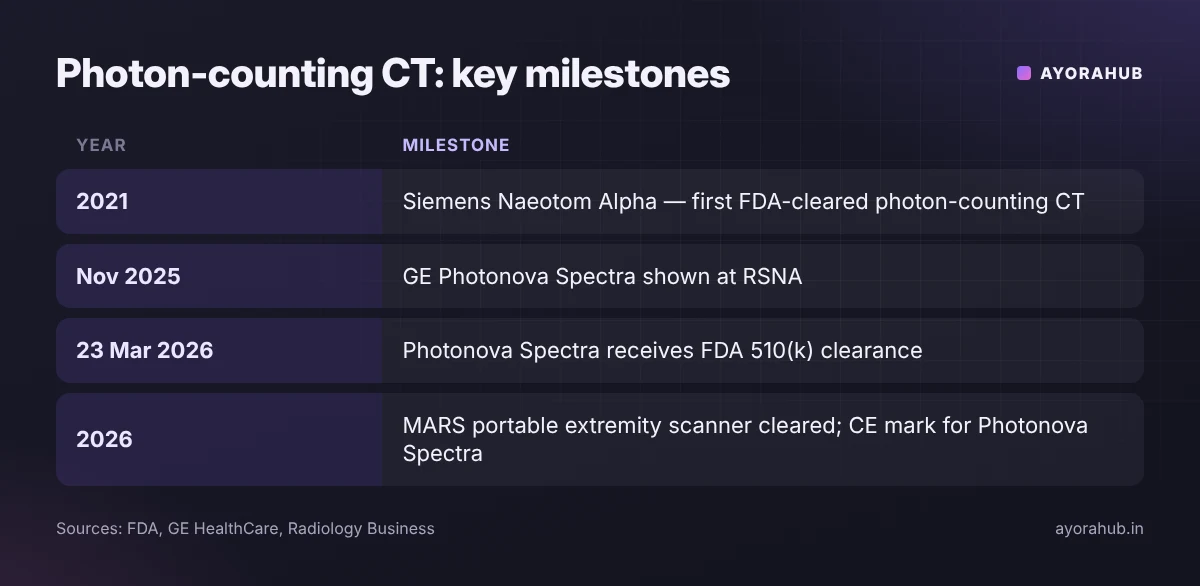
Quick answer (updated November 2026): Photon-counting CT (PCCT) is a new kind of CT scanner. A conventional scanner first turns X-rays into light and then into an electrical signal. A photon-counting scanner counts each X-ray photon directly and measures its energy. That can give sharper images and extra “spectral” information about what tissue is made of. Siemens Healthineers launched the first clinical system, Naeotom Alpha, after FDA clearance in 2021. In March 2026, GE HealthCare’s Photonova Spectra, built on a “Deep Silicon” detector, received FDA 510(k) clearance, and New Zealand’s MARS Bioimaging won clearance for a portable photon-counting scanner for arms and hands.
CT scans are among the most common hospital tests, so a better detector affects millions of patients. This explainer covers how photon-counting works, which machines are available in 2026, the potential benefits and the open questions. It is a technology explainer, not medical advice.

Conventional CT vs photon-counting CT
| Conventional CT | Photon-counting CT | |
|---|---|---|
| How X-rays are detected | Converted to visible light, then to an electrical signal | Each photon converted directly into an electrical pulse and counted |
| Energy information | Mostly lost (needs special dual-energy scans) | Measured for every photon, in every scan |
| Detail (spatial resolution) | Limited by the light-conversion layer | Potentially higher — smaller detector elements |
| Electronic noise | Adds to the image, especially at low dose | Largely filtered out by energy thresholds |
| Availability | Almost every hospital | Leading centres; spreading |
How does photon-counting CT work?
X-rays pass through the body and hit a detector. In a photon-counting detector, a semiconductor material turns each incoming photon straight into a small electrical pulse. The size of the pulse shows the photon’s energy, so the scanner can sort photons into energy “bins”. Manufacturers use different materials: Siemens uses cadmium telluride, while GE HealthCare uses silicon sensors placed edge-on (“Deep Silicon”).
Because energy is recorded in every scan, doctors can create spectral images afterwards — for example, images that highlight iodine contrast or reduce metal artefacts — without planning a special scan in advance.
Photon-counting CT scanners in 2026
| System | Company | Status | Notes |
|---|---|---|---|
| Naeotom Alpha | Siemens Healthineers | FDA cleared 2021; family expanded since | First clinical photon-counting CT |
| Photonova Spectra | GE HealthCare | FDA 510(k) clearance 23 March 2026; CE mark followed | Deep Silicon detector, 8 energy bins, designed to fit existing GE CT rooms |
| Extremity Scanner System | MARS Bioimaging | FDA 510(k) clearance | Compact scanner for upper limbs, for clinics and urgent care |
Swipe to see more →
GE HealthCare first showed Photonova Spectra at the RSNA 2025 radiology meeting. The company describes “8-bin” energy resolution and a “one-scan” workflow intended to make spectral imaging routine.
Potential benefits for patients
- Finer detail: useful for small structures such as coronary arteries, stents, the inner ear and lung tissue.
- Better tissue information: spectral data can help tell materials apart, such as calcium and contrast agent.
- Less noise at low dose: which may allow lower radiation or contrast doses in some scans. Actual savings depend on the scan and the hospital’s settings.
These are potential advantages reported by manufacturers and early studies. Large, long-term comparisons for many conditions are still being done.
Limits and open questions
- Cost: photon-counting scanners are more expensive, so access is limited at first.
- Data volume: they produce far more data, needing powerful computers and storage.
- Evidence: better images do not automatically mean better health outcomes; studies are ongoing.
- Radiation: it is still a CT scan and still uses X-rays.
Do you need a photon-counting CT scan?
For most routine scans, a modern conventional CT gives your doctor what they need. Photon-counting may be chosen for specific questions, such as detailed heart or lung imaging, where it is available. Do not delay a recommended scan to look for a newer machine — ask your doctor which test fits your situation.
Tools we recommend · Affiliate links: we may earn a commission if you sign up, at no extra cost to you.


Frequently Asked Questions
What is photon-counting CT in simple words?
A CT scanner whose detector counts individual X-ray photons and measures their energy, giving sharper images and extra information about tissue.
Who makes photon-counting CT scanners?
Siemens Healthineers (Naeotom Alpha), GE HealthCare (Photonova Spectra, cleared March 2026) and MARS Bioimaging (a compact extremity scanner). Other makers are developing systems.
Is photon-counting CT FDA approved?
Yes. The first system was cleared in 2021, and GE HealthCare’s Photonova Spectra received 510(k) clearance on 23 March 2026.
Does photon-counting CT use less radiation?
It can reduce image noise, which may allow lower doses in some scans, but the dose depends on the type of scan and settings.
Is photon-counting CT better than MRI?
They are different tests. CT uses X-rays and is fast; MRI uses magnets and shows soft tissue differently. Your doctor chooses based on the medical question.
What is Deep Silicon?
GE HealthCare’s name for its silicon-based photon-counting detector used in Photonova Spectra.
Conclusion
Medical technology in 2026 is moving from single breakthrough machines to connected systems: robots, scanners and software that share data and use AI. The promise is real, but so is the need for evidence and skilled people. See the full picture in new medical technology in 2026 and related guides: surgical robots in 2026, brain-computer interfaces, AI medical devices.
Medical disclaimer
This article explains technology for general information only. It is not medical advice and does not recommend any device, test or treatment. Always consult a qualified doctor about your own health.
How we researched this
We used company press releases and regulatory filings, FDA information and coverage by medical-technology trade publications, checked in November 2026. Performance claims by manufacturers are identified as such. Regulatory status is for the United States unless stated and can change; availability differs by country.
Sources
- GE HealthCare – Photonova Spectra receives FDA clearance
- GE HealthCare Research – Photon-counting CT and Deep Silicon
- Imaging Technology News – Photonova Spectra gains international access
- Radiology Business – FDA clears portable photon-counting CT scanner
- FDA – First major CT imaging advancement in nearly a decade (2021)