Last updated:
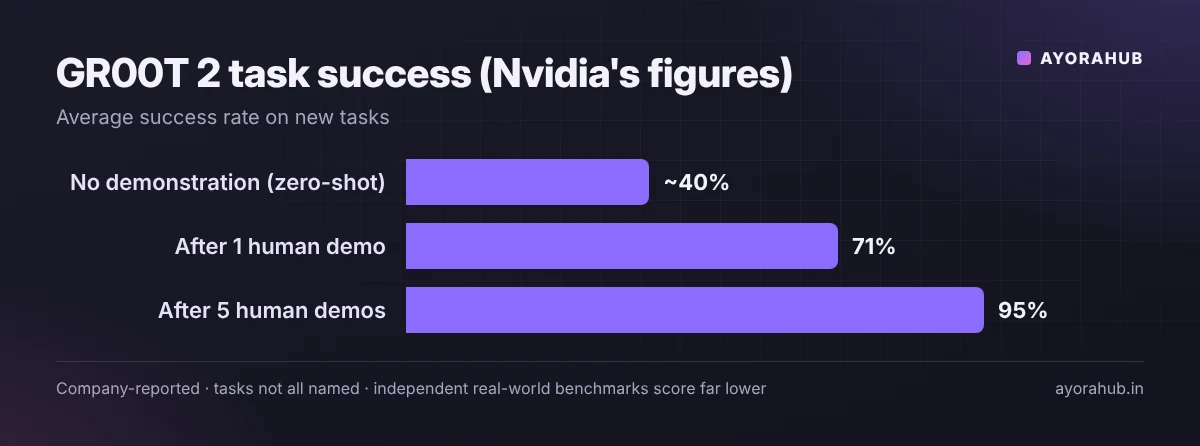
Quick answer (updated 11 November 2026): Nvidia GR00T 2 is a new AI model for humanoid robots, announced on 9 November 2026 at the Conference on Robot Learning (CoRL) in Austin. It is a 2-billion-parameter “world action model”: it predicts what the robot’s camera will see next and the movements needed to get there, at the same time. Nvidia says a robot running GR00T 2 succeeded at a new task 71% of the time after watching a single human demonstration, and 95% after five. Nvidia also released Isaac Lab 3.0, its robot-training simulator, and new open benchmarks. Important caveats: these are Nvidia’s own results, the tasks were not all named, and independent tests of similar models show much lower real-world scores.
Chatbots learned from the internet’s text. Robots have no such library of “how to move” — which is why teaching them is slow. GR00T 2 is Nvidia’s attempt to change that by letting robots learn from video of people. This guide explains what it is, how it works, what the numbers mean and how far robots still are from your home.

GR00T 2 at a glance
| Item | Details (per Nvidia and coverage) |
|---|---|
| Announced | 9 November 2026, CoRL 2026, Austin, Texas |
| Type | World action model for humanoid robots |
| Size | 2 billion parameters, built on Nvidia’s Cosmos-Predict2.5 video model |
| Headline claim | 71% average success after 1 human demo; 95% after 5 demos |
| Also reported | About 40% success with no demo on 50 tasks not in the robot’s training data |
| Released alongside | Isaac Lab 3.0; open benchmarks DexBench and VABAR |
| Availability | Weights and recipes “coming December”, per Nvidia’s Jim Fan; not yet downloadable as of mid-November, and no licence published yet |
| Early users named | Foxconn, Siemens and robotics start-ups |
What is a “world action model”?
Earlier robot models, including previous GR00T versions, were vision-language-action (VLA) models: they look at camera images, read an instruction and output motor commands. A world action model goes a step further. It also predicts the future video — what the scene should look like a moment from now if the task goes well — and produces actions that make that prediction come true.
Why does that help? Predicting video forces the model to learn basic physics: objects fall, doors swing, liquids pour. And because the model “thinks” in video, it can learn from ordinary videos of humans doing tasks, not only from expensive robot recordings.
How robots learn with GR00T 2
- Pre-training: the model learns general physical behaviour from huge amounts of video and robot data.
- Simulation: in Isaac Lab, thousands of virtual robots practise in parallel, far faster than real time.
- Demonstration: a person shows the task — in Nvidia’s tests, between one and five times.
- Execution: the robot performs the task, predicting upcoming frames and adjusting its movements.
How to read the 95% claim
- It is a company result. Reporters noted that Nvidia’s announcement did not name every task or say how many attempts were counted.
- Different numbers measure different things. 71% and 95% are with human demonstrations; about 40% is “zero-shot”, with none.
- Independent benchmarks are tougher. On RoboDojo, a hard real-world test suite, the best reported score for any model was 12.8% — not directly comparable, but a reminder that lab demos and messy reality differ.
- Success rate is not safety. A robot that works 95% of the time fails once in twenty attempts — acceptable for sorting parts, not for handling a hot pan near a child.
What is Isaac Lab 3.0?
Isaac Lab is Nvidia’s open framework for training robots in simulation. Version 3.0 arrived with GR00T 2, together with two open industrial benchmarks — DexBench and VABAR — developed with partners including UC Berkeley. Shared benchmarks matter because they let different labs compare robots on the same tasks.
Who is building humanoid robots?
Nvidia does not make robots; it supplies the “brain” software, simulators and chips. The robots come from companies such as Tesla (Optimus), Figure, Agility Robotics, Boston Dynamics, Unitree and others. Nvidia named manufacturers including Foxconn and Siemens among those testing or using GR00T 2 — a sign that factories and warehouses are the first target, not homes.
When will robots help at home?
Not soon. Homes are far less predictable than factories, and household robots must be safe, cheap and reliable for years. Expect the 2020s to bring robots to structured workplaces first; general home helpers need big advances in reliability, safety certification and cost.
Advantages and limitations
| Advantages | Limitations |
|---|---|
| Learns new skills from very few demonstrations | Results so far are self-reported |
| Can use human video, which is plentiful | Real-world reliability is far below lab demos in independent tests |
| Open tools and benchmarks lower the barrier for researchers | Licence and release date of weights not confirmed |
| Simulation makes training faster and safer | Hardware cost, battery life and safety remain unsolved |
Tools we recommend · Affiliate links: we may earn a commission if you sign up, at no extra cost to you.
Frequently Asked Questions
What is Nvidia GR00T 2?
A 2-billion-parameter AI model for humanoid robots that predicts future video and robot actions together, announced on 9 November 2026.
What does GR00T stand for?
Nvidia introduced the name as “Generalist Robot 00 Technology”.
How is GR00T 2 different from earlier versions?
Earlier versions were vision-language-action models. GR00T 2 is a world action model that also predicts upcoming video frames, which helps it learn from human videos.
Is GR00T 2 open source?
Nvidia calls it an open model. Reports say weights are due in December, but a licence and date had not been published at the time of writing.
Does Nvidia make humanoid robots?
No. It provides AI models, simulation software and chips for robot makers.
Can I buy a humanoid robot for my home?
A few early products exist, but capable, safe and affordable home robots are still years away.
Conclusion
GR00T 2 marks a shift in robotics from programming each movement to showing a robot what to do. The claims are impressive and still need independent proof. Watch for the weight release and third-party tests in the coming weeks. Related reading: surgical robots in 2026, Google’s TPU 8 AI chips and AI agents for software.
How we researched this
We used Nvidia’s announcement at CoRL 2026 and coverage by Unite.AI, Humanoids Daily, Tech Times and others, published 9–10 November 2026. Success rates are Nvidia’s figures; we include reporters’ caveats. The list of robot makers is general background.
Sources
- Jim Fan (Nvidia) – Introducing GR00T 2
- Humanoids Daily – Nvidia unveils GR00T 2 and open-sources the stack
- The Neuron – GR00T 2: human video, robot learning and caveats
- NVIDIA Robotics – GR00T 2 announcement at CoRL 2026
- Unite.AI – NVIDIA introduces GR00T 2
- Humanoids Daily – NVIDIA unveils GR00T 2 and open-sources the stack
- Tech Times – GR00T 2 reports 95% success, with caveats
- Runtime Wire – GR00T 2 and Isaac Lab 3.0