Last updated:
Quick answer (updated 11 November 2026): Google TPU 8 is the eighth generation of Google’s own AI chips (Tensor Processing Units), which run Gemini and are rented to customers through Google Cloud. For the first time, Google split the line in two: TPU 8t for training AI models and TPU 8i for inference (answering requests). On 9 November 2026 it added two more systems: TPU 8tx, for confidential (privacy-protected) inference, and TPU 8i Max, which packs two 8i chips into one package for roughly double the compute. Google has not published full benchmarks or prices for the new systems, and independent analysts say raw per-chip specs still trail Nvidia’s best — Google’s advantage is scale, cost and tight integration with its own software.
Nvidia’s GPUs dominate AI, but the biggest cloud companies now design their own chips. This guide explains what a TPU is, how the four TPU 8 systems differ, how they compare with Nvidia GPUs, and why any of it matters to people who just use AI apps.
What is a TPU?
A Tensor Processing Unit is a chip Google designed specifically for the maths of neural networks. A GPU is a general-purpose parallel processor that happens to be excellent at AI; a TPU is an ASIC — an application-specific chip — built to do only AI workloads as efficiently as possible. Google has used TPUs internally since 2015 for Search, Translate, Photos and now Gemini. You cannot buy one: you rent TPU time on Google Cloud.
The TPU 8 family
| System | Announced | Built for | Key details (per Google and coverage) |
|---|---|---|---|
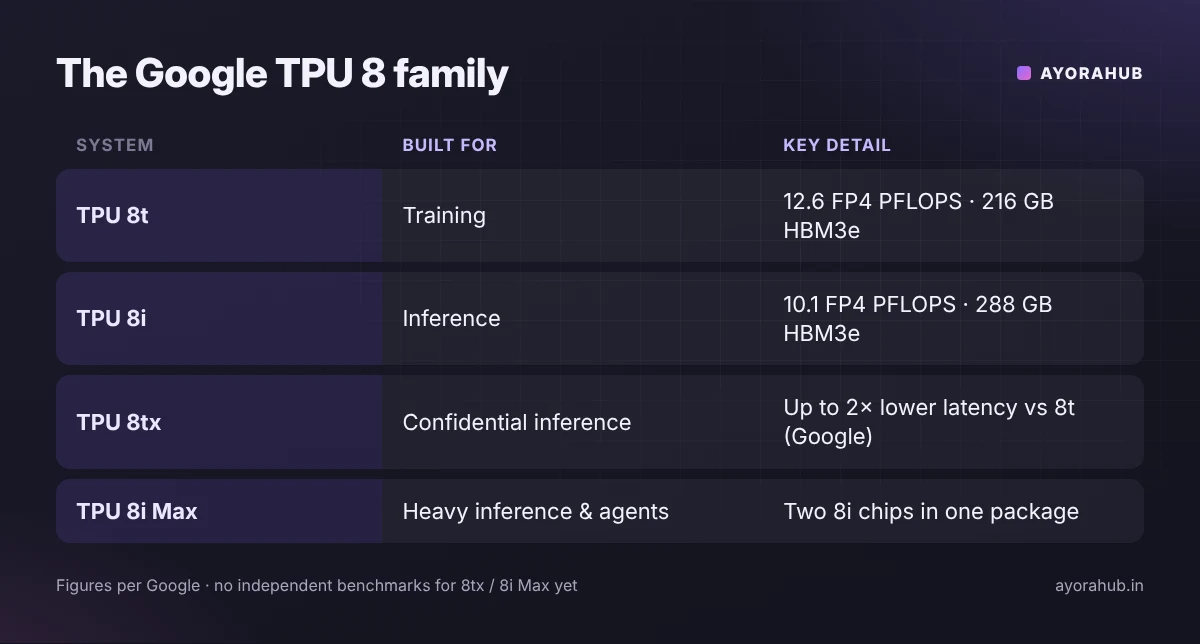
| TPU 8t | April 2026 | Training large models | 12.6 FP4 petaFLOPS; 216 GB HBM3e memory |
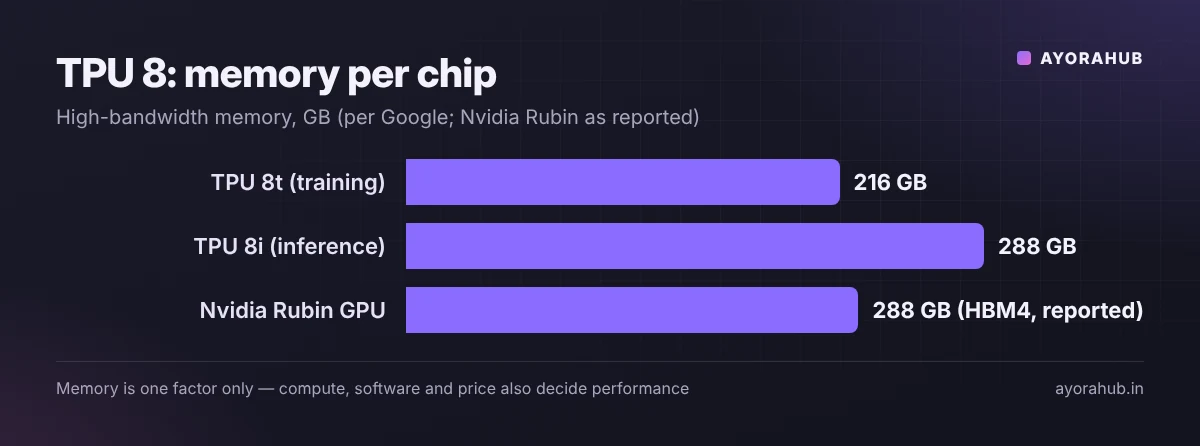
| TPU 8i | April 2026 | Inference at scale | 10.1 FP4 petaFLOPS; 288 GB HBM3e; 384 MB on-chip SRAM |
| TPU 8tx | 9 Nov 2026 | Confidential inference | Uses 8t silicon with 5th-gen AMD EPYC host processors; Google claims up to 2× lower latency than 8t |
| TPU 8i Max | 9 Nov 2026 | Heavier inference, agents, long context | Two 8i chips in one package — about double the compute, SRAM and memory bandwidth |
Swipe to see more →
Google also says TPU 8 clusters can scale to as many as one million TPUs, linked by its own networking.
Training vs inference: why two chips?
- Training is teaching a model: enormous computations over weeks, where raw throughput matters most.
- Inference is using the model: billions of short requests, where speed per request, memory and cost per answer matter most.
As AI moves from building models to serving them — especially AI agents that run for a long time and hold large contexts — inference is becoming the larger workload. That is why Google gave it a dedicated chip and now a “Max” version.
What is confidential inference (TPU 8tx)?
Normally, data must be decrypted in memory while a chip processes it. Confidential computing keeps the data inside a hardware-protected “enclave” that even the cloud provider’s own staff and software cannot read. TPU 8tx brings that protection to AI inference, which matters to banks, hospitals and governments that want to use AI on sensitive data.
Google TPU vs Nvidia GPU
| Google TPU 8 | Nvidia GPUs | |
|---|---|---|
| Type | Custom AI chip (ASIC) | General-purpose GPU |
| Who can use it | Google itself and Google Cloud customers | Anyone: every major cloud, plus direct purchase |
| Software | Google’s stack (JAX, TensorFlow, PyTorch support) | CUDA — the industry standard ecosystem |
| Raw per-chip performance | Analysts say it does not close the gap with Nvidia’s or AMD’s best | Generally the leader |
| Strength | Cost and power efficiency at huge scale; designed together with Google’s models | Flexibility, software ecosystem, availability |
In short: Nvidia sells the best general tool to everyone; Google builds a specialised tool for itself and its cloud customers. Other companies do the same — Amazon has Trainium and Microsoft has Maia.
Why this matters to you
- Cheaper AI: the price of AI answers depends on chip costs. Efficient inference chips are one reason API prices keep falling — see Gemini 4 pricing.
- Faster, longer conversations: more memory bandwidth supports bigger context windows and agents.
- Privacy: confidential inference could make AI usable for sensitive data.
- Competition: alternatives to Nvidia reduce supply bottlenecks for the whole industry.
What we still don’t know
- Absolute performance figures, benchmarks and prices for TPU 8tx and 8i Max.
- Which Google Cloud regions will offer them, and when.
- How they compare with Nvidia’s newest Rubin-generation GPUs in independent tests.
Tools we recommend · Affiliate links: we may earn a commission if you sign up, at no extra cost to you.
Frequently Asked Questions
What does TPU stand for?
Tensor Processing Unit — Google’s custom chip for AI workloads.
What is the difference between TPU 8t and TPU 8i?
8t is optimised for training AI models; 8i is optimised for inference, which is running them for users.
What is TPU 8tx?
A system announced on 9 November 2026 for confidential inference, built on TPU 8t silicon.
What is TPU 8i Max?
A package containing two TPU 8i chips, with roughly double the compute, SRAM and memory bandwidth of a single 8i.
Is Google’s TPU better than Nvidia’s GPUs?
Not on raw per-chip specs, according to independent analysis. TPUs aim to win on efficiency and cost at very large scale inside Google’s own data centres.
Can I buy a Google TPU?
No. TPUs are available only as a service on Google Cloud.
Conclusion
TPU 8 shows where AI hardware is heading: separate chips for training and inference, built-in privacy, and clusters of up to a million processors. For users, the result should be faster and cheaper AI. Related reading: Mistral Large 4 and its hardware needs, GPT-6 models explained and the best AI chatbots of 2026.
How we researched this
We used Google Cloud’s TPU page and coverage of Google’s April and November 2026 announcements by Tom’s Hardware, Business Standard and MarkTechPost. Performance figures are Google’s own; no independent benchmarks of the new systems were available at the time of writing.