Last updated:
Quick answer (updated 11 November 2026): Three serious security updates landed this week, and two of the flaws are already being used by attackers. Google Chrome fixed an actively exploited zero-day (CVE-2026-125350) — update to version 157.0.8103.50/.51 or later. Microsoft’s November Patch Tuesday fixed more than 1,000 flaws, including an exploited Outlook zero-day (CVE-2026-124194) that leaks your Windows login hash when you open a malicious file. And OpenSSH “SSHole” (CVE-2026-123158) lets attackers log in without a valid password on Alpine Linux servers — fixed in OpenSSH 10.6p2. Apple also shipped iOS 27.2.1 with security fixes. Update your browser, Windows, Office and phones today.
You do not need to be a security expert to stay safe — you need to install updates quickly. This guide explains each flaw in plain English, who is affected, and the exact steps to update.
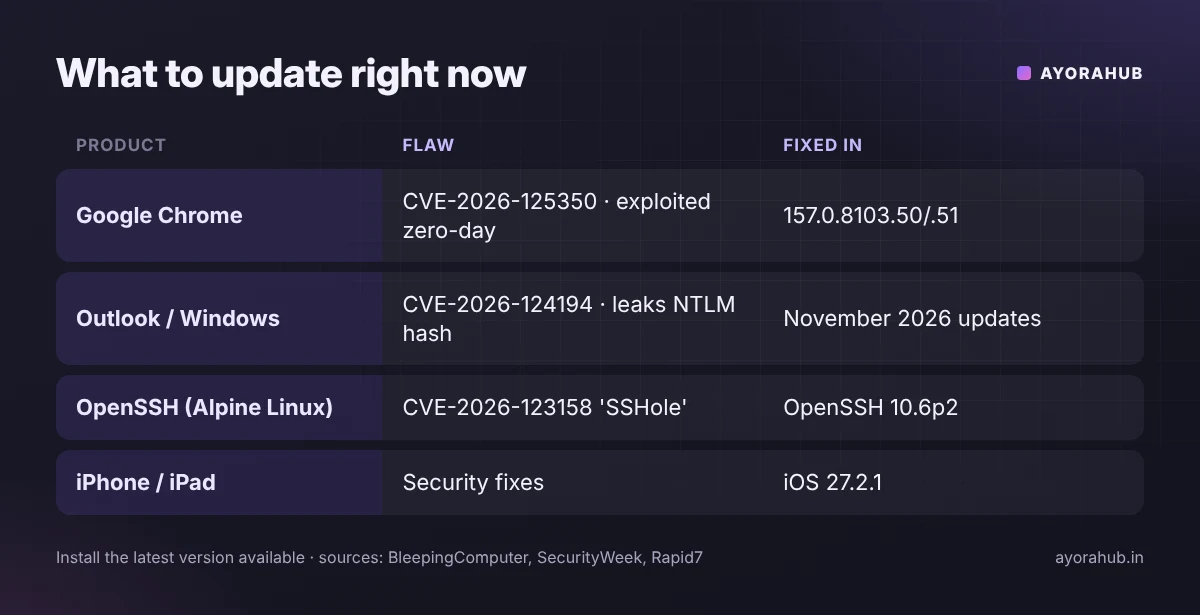
What to update right now
| Product | Flaw | Exploited? | Fixed in |
|---|---|---|---|
| Google Chrome (desktop) | CVE-2026-125350 — use-after-free in the XML component | Yes | 157.0.8103.50/.51 (Windows, Mac), 157.0.8103.50 (Linux) |
| Microsoft Outlook / Windows | CVE-2026-124194 — spoofing flaw that leaks NTLMv2 hashes | Yes | November 2026 security updates (10 Nov) |
| OpenSSH on Alpine Linux (musl, no PAM) | CVE-2026-123158 “SSHole” — password authentication bypass | Yes (reported) | OpenSSH 10.6p2; Alpine 3.21.10, 3.22.8, 3.23.8, 3.24.4 |
| iPhone / iPad | Security fixes | — | iOS 27.2.1 (also 26.7.3 and 18.7.12 for older devices) |
Swipe to see more →
1. Chrome zero-day: CVE-2026-125350
On 9 November 2026, Google released a Chrome update that fixes a use-after-free bug in the browser’s XML handling. In simple terms, the browser could be tricked into using memory it had already released, which attackers can abuse to run their own code — often just by getting you to open a malicious web page. Google confirmed that an exploit exists in the wild. It is the eighth actively exploited Chrome zero-day of 2026, according to security reporters. The same update fixes eight other flaws.
How to update Chrome
- Open Chrome and click the three-dot menu → Help → About Google Chrome.
- Chrome checks for updates and downloads the new version.
- Click Relaunch. The version should read 157.0.8103.50 or higher.
Using Edge, Brave, Opera or Vivaldi? They are built on the same Chromium engine. Open their “About” page and install their update as soon as it is offered.
2. Microsoft Patch Tuesday: an Outlook zero-day
Microsoft’s 10 November 2026 release is one of its largest ever: security firms count between about 1,090 and 1,235 fixes depending on how they count, with more than 60 rated critical. The most urgent is CVE-2026-124194 in Outlook.
- What it does: opening a specially crafted file makes Outlook silently connect to a server controlled by the attacker and send your NTLMv2 hash — a scrambled form of your Windows password.
- Why it matters: attackers can relay that hash to log in as you on other company systems, or try to crack it offline.
- Good news: researchers say the Preview Pane is not an attack route — you have to open the file. Microsoft rates it “Moderate” (CVSS 6.5), but it is already being exploited.
How to update Windows and Office
- Go to Settings → Windows Update → Check for updates, install everything and restart.
- In any Office app: File → Account → Update Options → Update Now.
- Until you have updated, do not open unexpected attachments — especially
.msgfiles.

3. OpenSSH “SSHole”: CVE-2026-123158
SSH is how administrators log in to servers remotely. “SSHole” is a password authentication bypass in OpenSSH’s server on Linux systems that use the musl C library without PAM — most notably Alpine Linux, which is popular in containers. Accounts that were supposed to have password login disabled could be logged into with a specially crafted password.
- Fixed in: OpenSSH 10.6p2 (released 5 November 2026). Alpine shipped patched packages, including point releases 3.21.10, 3.22.8, 3.23.8 and 3.24.4.
- Exploitation: researchers reported attacks within hours of disclosure, including root access on a test “honeypot” server, and the flaw was reported added to the US CISA Known Exploited Vulnerabilities catalogue on 9 November.
- Who is not affected: typical Ubuntu, Debian, Fedora and RHEL servers use glibc and PAM, which are outside the affected configuration. Still, install your distribution’s updates.
What server owners should do
- On Alpine: run
apk update && apk upgrade openssh, then restartsshd. Rebuild container images that include an SSH server. - Check the version with
ssh -V. - Do not expose SSH to the whole internet if you can avoid it: use a firewall, a VPN or allow-listed IPs, and key-based login.
- Review login logs for unexpected successful logins since early November.
4. iPhone and iPad
Apple released iOS 27.2.1, along with 26.7.3 and 18.7.12 for older devices, as security updates. Go to Settings → General → Software Update and install.
Simple habits that block most attacks
- Turn on automatic updates for your browser, operating system and phone.
- Restart your browser at least once a week — updates only apply after a relaunch.
- Do not open unexpected attachments, even from known contacts.
- Use two-factor authentication or passkeys, so a stolen password hash is not enough. See how SSO and two-factor login work.
- Beware of fake “update” or “verification” pages — real updates come from the app itself. See fake CAPTCHA scams.
Tools we recommend · Affiliate links: we may earn a commission if you sign up, at no extra cost to you.

Frequently Asked Questions
What is a zero-day vulnerability?
A security flaw that attackers are already exploiting before, or just as, the maker releases a fix — leaving defenders “zero days” to prepare.
Which Chrome version fixes CVE-2026-125350?
157.0.8103.50/.51 for Windows and Mac, and 157.0.8103.50 for Linux, or any later version.
Is the Outlook zero-day triggered by just previewing an email?
Researchers say no — the Preview Pane is not an attack route. The user has to open a malicious file.
Am I affected by SSHole?
Only if you run an OpenSSH server on a musl-based Linux system without PAM, such as Alpine Linux. Home Windows and Mac users are not affected.
How many flaws did Microsoft fix in November 2026?
More than 1,000. Counts from security firms range from about 1,090 to 1,235, depending on what is included.
Do I need antivirus if I install updates?
Updates are the most important defence. Built-in protection such as Microsoft Defender plus careful habits is enough for most people.
Conclusion
Update Chrome, Windows, Office and your phone today; if you run Alpine-based servers, patch OpenSSH immediately. Most successful attacks use flaws that already have a fix — the fastest updaters are the safest users. More safety guides: QR code scams and Black Friday shopping scams.
How we researched this
We used reporting from BleepingComputer, The Hacker News, SecurityWeek, Rapid7, CSO Online and Malwarebytes, published 5–11 November 2026. Security firms count Microsoft’s fixes differently, so we give the range. Version numbers can be superseded by newer releases — always install the latest available update.
Sources
- BleepingComputer – Google patches eighth Chrome zero-day of 2026
- SecurityWeek – Chrome update patches exploited XML zero-day
- Malwarebytes – Update Chrome now
- Rapid7 – Patch Tuesday, November 2026
- CSO Online – November 2026 Patch Tuesday
- The Hacker News – OpenSSH SSHole exploited within hours
- SOCRadar – SSHole: OpenSSH password bypass on Alpine Linux
- Macworld – Apple releases iOS 27.2.1 security updates