Last updated:
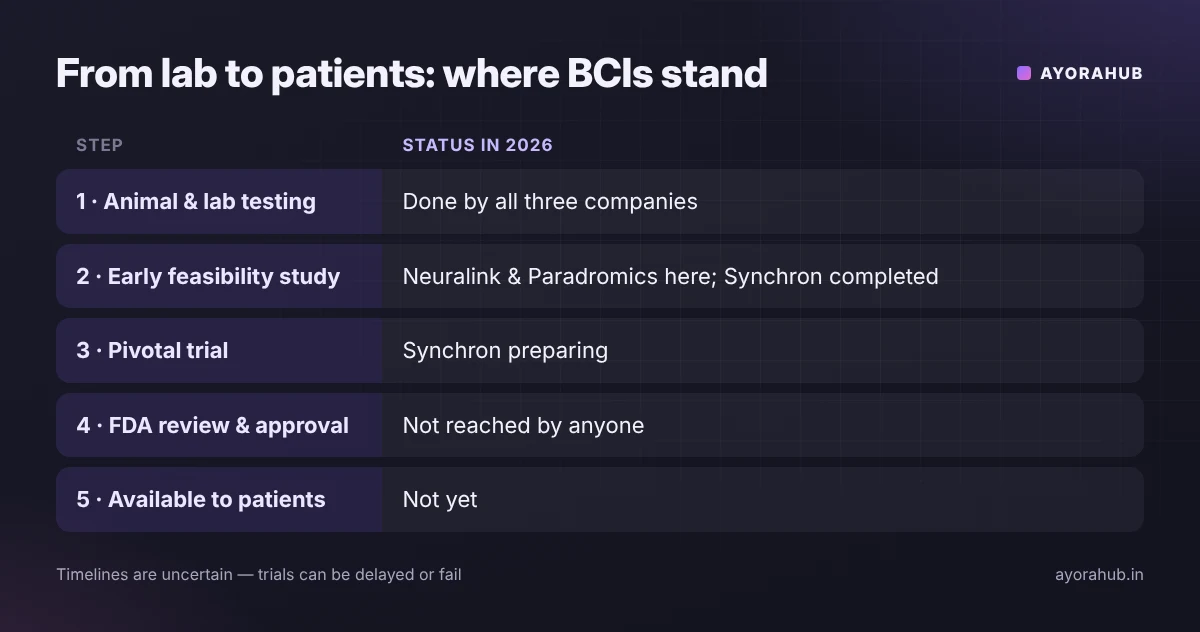
Quick answer (updated November 2026): A brain-computer interface (BCI) is a device that reads brain signals and turns them into actions — moving a cursor, typing text or producing speech — mainly to help people with paralysis. In 2026, brain-computer interfaces from three US companies lead human testing. Neuralink is running early feasibility trials of its skull-mounted implant, with about 26 participants reported across its trials by mid-2026. Synchron, whose Stentrode is placed through a blood vessel without open brain surgery, finished a six-patient study that met its safety goal and is preparing a larger pivotal trial. Paradromics completed its first Connexus implant in an FDA-approved study in June 2026. No BCI has full FDA approval yet — all are still in clinical trials.
“Brain chips” generate bold headlines. This guide separates what has actually been done in people from what is still a plan, explains how the three main devices differ, and looks at the risks and ethical questions. It is a technology explainer, not medical advice.
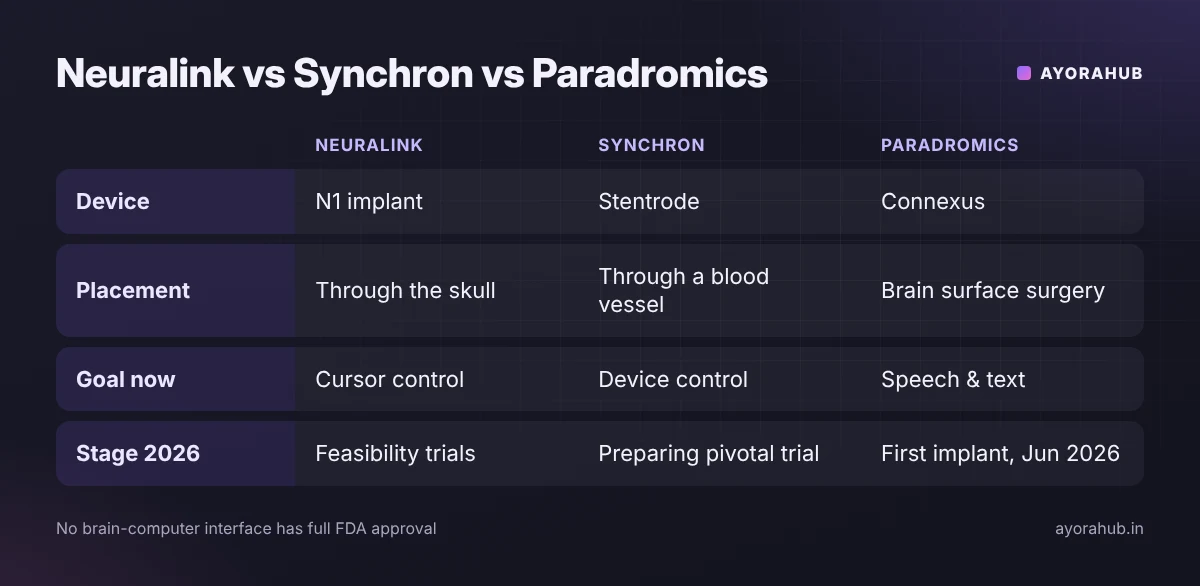
Neuralink vs Synchron vs Paradromics
| Neuralink | Synchron | Paradromics | |
|---|---|---|---|
| Device | N1 implant (“Link”) | Stentrode | Connexus |
| How it is placed | Opening in the skull; thin threads inserted into the brain by a robot | Through a blood vessel, like a stent — no open brain surgery | Surgery to place electrode arrays on the brain’s surface layer |
| Main goal now | Cursor and device control for people with paralysis | Hands-free control of phones and computers | Restoring communication (speech and text) |
| Stage (2026) | Early feasibility trials (PRIME study and others) | Early study complete; preparing pivotal trial | First implant in FDA-approved early feasibility study, June 2026 |
| Reported so far | About 26 participants across trials by 30 June 2026 (as reported) | 6-patient, 12-month study met primary safety endpoint; US$200M raised Nov 2025 | Study to enrol two participants initially; sites include University of Michigan |
Swipe to see more →
How does a brain-computer interface work?
- Sensors near or inside the brain pick up electrical activity from neurons in the area that controls movement or speech.
- A small implant amplifies the signals and sends them, usually wirelessly, to a computer.
- Software trained with AI learns which patterns match what the person intends — for example, “move the cursor left” or the sounds of a word.
- The computer acts: it moves a cursor, types, controls a device or speaks through a synthetic voice.
The closer the sensors are to neurons, the more detailed the signal — but the more invasive the surgery. That trade-off is the main difference between the companies.
What happened in 2026
- Paradromics: on 17 June 2026 it announced the first implantation in its FDA-approved Connect-One early feasibility study, at University of Michigan Health, in a participant with motor neuron disease. The study focuses on restoring communication.
- Neuralink: continued enrolling in its PRIME feasibility study; the company and third-party reports describe steady growth in participants and improvements in how quickly the system calibrates.
- Synchron: after its COMMAND study met its primary safety endpoint, the company raised US$200 million in late 2025 to fund a pivotal trial — the large study normally needed before applying for approval.
Who could benefit?
- People with paralysis from spinal cord injury or stroke
- People with ALS / motor neuron disease who are losing the ability to speak or move
- In the longer term, researchers are exploring vision restoration and other uses — these are at an earlier stage
Today, access is only through clinical trials with strict entry criteria.
Risks and ethical questions
| Area | Concern |
|---|---|
| Surgery | Infection, bleeding and the risks of anaesthesia; devices may shift or stop working |
| Long-term reliability | How well implants keep working over many years is still being studied |
| Privacy | Brain data is deeply personal; who stores it and how is it protected? |
| Support | What happens to patients if a company closes or stops supporting a device? |
| Cost and access | Who will be able to afford approved devices? |
When will brain implants be available?
No one can give a firm date. A device must complete a pivotal trial and an FDA review before approval. Analysts often suggest the late 2020s for the first approvals, but that is speculation — trials can be delayed or fail. Be cautious about any clinic or website offering “brain chip” treatment today.
Tools we recommend · Affiliate links: we may earn a commission if you sign up, at no extra cost to you.


Frequently Asked Questions
What is a brain-computer interface?
A device that reads brain signals and translates them into commands for a computer or other device.
Is Neuralink approved by the FDA?
No. Neuralink has FDA permission to run clinical trials, but its implant is not approved for general use.
How is Synchron different from Neuralink?
Synchron’s Stentrode is delivered through a blood vessel and does not need open brain surgery; Neuralink’s implant is placed through an opening in the skull with threads inserted into the brain.
What did Paradromics do in 2026?
It completed the first implant of its Connexus BCI in an FDA-approved early feasibility study in June 2026.
Can a brain-computer interface read my thoughts?
No. Current devices decode specific signals, such as intended movement or attempted speech, after training — not private thoughts in general.
Can healthy people get a brain implant?
No. Trials are limited to people with serious medical conditions such as paralysis.
Conclusion
Medical technology in 2026 is moving from single breakthrough machines to connected systems: robots, scanners and software that share data and use AI. The promise is real, but so is the need for evidence and skilled people. See the full picture in new medical technology in 2026 and related guides: surgical robots in 2026, photon-counting CT, AI medical devices.
Medical disclaimer
This article explains technology for general information only. It is not medical advice and does not recommend any device, test or treatment. Always consult a qualified doctor about your own health.
How we researched this
We used company press releases and regulatory filings, FDA information and coverage by medical-technology trade publications, checked in November 2026. Performance claims by manufacturers are identified as such. Regulatory status is for the United States unless stated and can change; availability differs by country.