Last updated:
Quick answer (updated November 2026): In 2026, surgical robots are no longer a one-company market. Intuitive’s da Vinci 5 remains the leader and was cleared for certain heart procedures in 2026. Medtronic’s Hugo entered the US after FDA clearance for urology in December 2025 and added a real-time AI tool in July 2026. Johnson & Johnson’s OTTAVA, with arms built into the operating table, won FDA De Novo authorization in July 2026 for general surgery. And India’s SSi Mantra reports 225 systems installed in India — close to da Vinci’s 275 there — while its US application is still under FDA review. In every system, a surgeon controls the robot; none operates on its own.
Robotic surgery lets surgeons operate through small cuts using wristed instruments and a magnified 3D camera. This guide compares the four systems making news in 2026, explains what “FDA cleared” really means, and lists the questions patients should ask. It is a technology explainer, not medical advice.
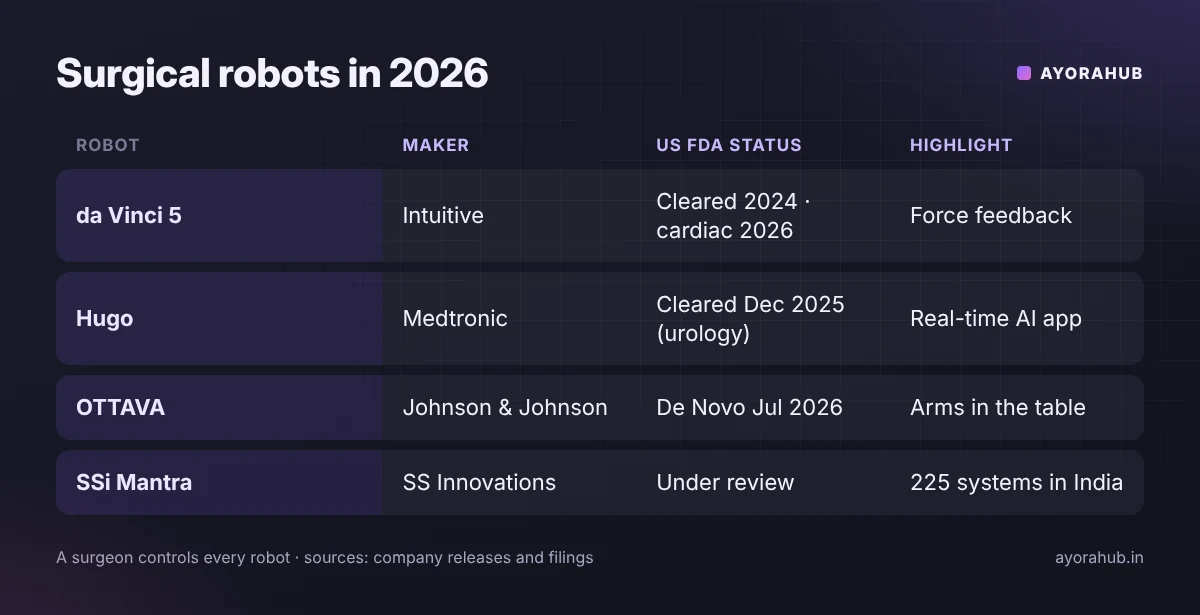
Surgical robots in 2026: comparison
| da Vinci 5 | Hugo | OTTAVA | SSi Mantra | |
|---|---|---|---|---|
| Company | Intuitive (USA) | Medtronic | Johnson & Johnson | SS Innovations (India) |
| Design | Patient cart with four arms; surgeon console | Modular: separate arm carts; open console | Arms integrated into the operating table | Modular arm carts; open-face console |
| US FDA status | Cleared March 2024; cardiac procedures added January 2026 | Cleared 3 December 2025 for urologic procedures | De Novo authorization 22 July 2026 (general surgery) | Under FDA review; not approved in the US |
| Highlight | Force feedback instruments | Real-time AI app (Instrument Exit Point), cleared July 2026 | Company says 30–50% less floor space | 12,375 procedures reported as of July 2026 |
Swipe to see more →
How robotic surgery works
- The surgeon makes a few small cuts and places thin tubes (ports).
- Robotic arms hold a 3D camera and tiny instruments through those ports.
- The surgeon sits at a console and moves hand controls; the robot copies the movements on a smaller scale and filters hand tremor.
- An assistant and nursing team stay at the patient’s side throughout.
The robot does not make decisions. Think of it as an extremely precise extension of the surgeon’s hands.
da Vinci 5: the market leader adds touch
Intuitive has led robotic surgery for more than two decades. The da Vinci 5, cleared by the FDA in March 2024, introduced force feedback — the surgeon can feel resistance from tissue — plus much more computing power for data and video. Intuitive’s filings report clearance in January 2026 for certain cardiac procedures, including mitral valve repair, and in March 2026 for updated force-feedback instruments.
Hugo: Medtronic’s modular challenger
Hugo uses separate, movable arm carts and an open console where the surgeon wears 3D glasses. The FDA cleared it on 3 December 2025 for minimally invasive urologic procedures; Medtronic expects general and gynaecologic indications to follow. In July 2026, the company announced FDA clearance of Instrument Exit Point, its first real-time AI application for robotic surgery, running on its Touch Surgery Aide platform.
OTTAVA: arms inside the table
J&J submitted OTTAVA to the FDA in January 2026 and received De Novo authorization on 22 July 2026. Its four arms are built into the operating table, so they move with the patient when the table tilts. The authorization covers general-surgery procedures in the upper abdomen, including Roux-en-Y gastric bypass, sleeve gastrectomy, gallbladder removal, appendectomy and small-bowel resection. A US trial for inguinal hernia repair is continuing, and J&J plans to launch with selected US customers.

SSi Mantra: India’s home-grown robot
SS Innovations, founded by cardiac surgeon Dr Sudhir Srivastava, builds the SSi Mantra in India. According to the company’s US securities filing (November 2026), 225 Mantra systems are installed in India, compared with 275 da Vinci systems, and 12,375 procedures had been performed with Mantra by 6 July 2026. The system has not been approved for sale in the United States; its application is under FDA review. A lower-cost, locally made robot matters for countries where the price of imported systems limits access.
Benefits and limits of robotic surgery
| Potential benefits | Limits and risks |
|---|---|
| Small incisions; precise, steady instruments | Not proven better than standard keyhole surgery for every operation |
| 3D magnified view for the surgeon | High equipment cost, which can raise the price |
| Less surgeon fatigue in long operations | Results depend heavily on the surgeon’s and team’s experience |
| Access to hard-to-reach areas | Like all surgery, carries risks such as bleeding and infection |
Questions to ask before robotic surgery
- How many of these operations have you done with this robot?
- What are the alternatives (open or standard laparoscopic surgery), and how do results compare for my condition?
- What is the total cost difference, and does my insurance cover it?
- What happens if the operation has to be converted to open surgery?
Tools we recommend · Affiliate links: we may earn a commission if you sign up, at no extra cost to you.


Frequently Asked Questions
Which is the best surgical robot in 2026?
There is no single best. da Vinci has the longest track record; Hugo, OTTAVA and Mantra are newer options. The surgeon’s experience with a system matters more than the brand.
Is OTTAVA approved by the FDA?
Yes. It received FDA De Novo authorization on 22 July 2026 for several general-surgery procedures.
Is the Medtronic Hugo robot FDA cleared?
Yes, since 3 December 2025, for urologic procedures.
Is SSi Mantra approved in the USA?
Not yet. The company says its application is under FDA review. It is in use in India.
Does the robot perform surgery by itself?
No. A surgeon controls every movement.
Is robotic surgery safer than normal surgery?
It depends on the operation and the team. Ask your surgeon about evidence for your specific procedure.
Conclusion
Medical technology in 2026 is moving from single breakthrough machines to connected systems: robots, scanners and software that share data and use AI. The promise is real, but so is the need for evidence and skilled people. See the full picture in new medical technology in 2026 and related guides: photon-counting CT, brain-computer interfaces, AI medical devices.
Medical disclaimer
This article explains technology for general information only. It is not medical advice and does not recommend any device, test or treatment. Always consult a qualified doctor about your own health.
How we researched this
We used company press releases and regulatory filings, FDA information and coverage by medical-technology trade publications, checked in November 2026. Performance claims by manufacturers are identified as such. Regulatory status is for the United States unless stated and can change; availability differs by country.