Last updated:
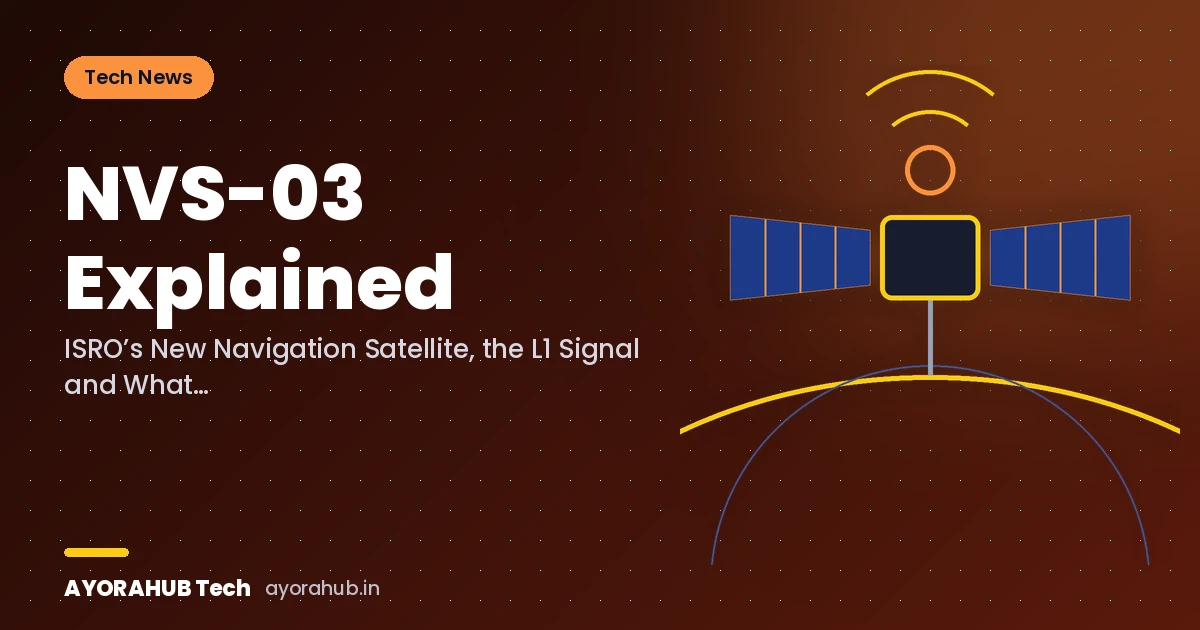
NVS-03 is India’s newest navigation satellite, launched by ISRO on a GSLV-F18 rocket from Sriharikota. It is the third satellite of ISRO’s next-generation navigation system, built to keep India’s regional navigation service (IRNSS, which India calls NavIC) running. In its update of 4 November 2026, ISRO said the satellite had reached its final geosynchronous orbit and that its health is normal.
Key facts at a glance
| Satellite | NVS-03 — third satellite of the next-generation navigation system, for continuity of IRNSS services |
|---|---|
| Launch vehicle | GSLV-F18, launched from the Second Launch Pad, Satish Dhawan Space Centre (SHAR) |
| Injection orbit | 170.3 km × 38,080 km (Geosynchronous Transfer Orbit) |
| Final orbit (4 Nov 2026 update) | Geosynchronous: 35,765 km × 36,196 km, inclination 29.98° |
| Orbit manoeuvres | Four completed; cumulative LAM engine burn of 6,164 seconds |
| Signals | New L1 signal in addition to L5 and S-band |
| Coverage | Indian land mass and a region extending 1,500 km around the Indian geopolitical boundary |
| Clocks | Indigenous atomic clock plus procured atomic clocks |
| Status | Satellite health normal (ISRO, 4 Nov 2026) |
A date note
ISRO’s mission page for GSLV-F18 is dated 28 October 2026, while ISRO’s 4 November update says the satellite was injected into orbit on 30 October 2026 at 23:51 hrs. We have used the 4 November update for the orbit details and are not stating a single “launch date” here; please check ISRO’s mission page for the official timeline.
Why the new L1 signal matters
Navigation chips work by listening to timing signals from satellites. India’s earlier satellites used L5 and S-band signals. ISRO says NVS-03 adds an L1 signal. L1 is a frequency band that many consumer navigation receivers already use for GPS, so an L1 signal makes it easier, in principle, for devices to use the Indian system too. ISRO’s page does not say which phones or chips will use it or when; that depends on device makers, so treat any such claim as unconfirmed until they announce it.
Why the atomic clock matters
Satellite navigation depends on extremely accurate clocks, because a tiny timing error becomes a big position error. ISRO notes that NVS-03 carries an indigenous atomic clock as well as procured ones — a step toward depending less on imported clocks.
What “continuity of IRNSS” means
NVS satellites are meant to continue and strengthen the existing IRNSS (NavIC) constellation. ISRO’s wording is about “continuity of navigation services”, so the goal is a reliable regional service over India and up to 1,500 km beyond its borders.
Exam angle (for students)
Likely questions: the satellite name (NVS-03), vehicle (GSLV-F18), launch site (Satish Dhawan Space Centre, SHAR), purpose (navigation, IRNSS/NavIC), new signal (L1) and coverage (up to 1,500 km beyond India’s boundary). Keep official wording in mind when you revise.
Frequently Asked Questions
What is NVS-03?
The third satellite of ISRO’s next-generation navigation system, built for continuity of IRNSS (NavIC) services.
Which rocket launched NVS-03?
GSLV-F18, from the Second Launch Pad at Satish Dhawan Space Centre, SHAR.
What is new in NVS-03?
ISRO says it carries an indigenous atomic clock and adds an L1 signal to the existing L5 and S-band signals.
Has NVS-03 reached its final orbit?
ISRO’s 4 November 2026 update says it reached geosynchronous orbit (35,765 km × 36,196 km) at 29.98° inclination, and its health is normal.
Will my phone use NVS-03 now?
ISRO has not said so. It depends on chipsets and phone makers.
Checked on 15 November 2026 against ISRO’s website. Details can be updated by ISRO.
How we checked this
We read ISRO’s GSLV-F18/NVS-03 mission page and ISRO’s “Final Orbit manoeuvring of NVS-03 spacecraft” update (4 November 2026). Plain-language explanations of L1 and atomic clocks are ours.