Last updated:
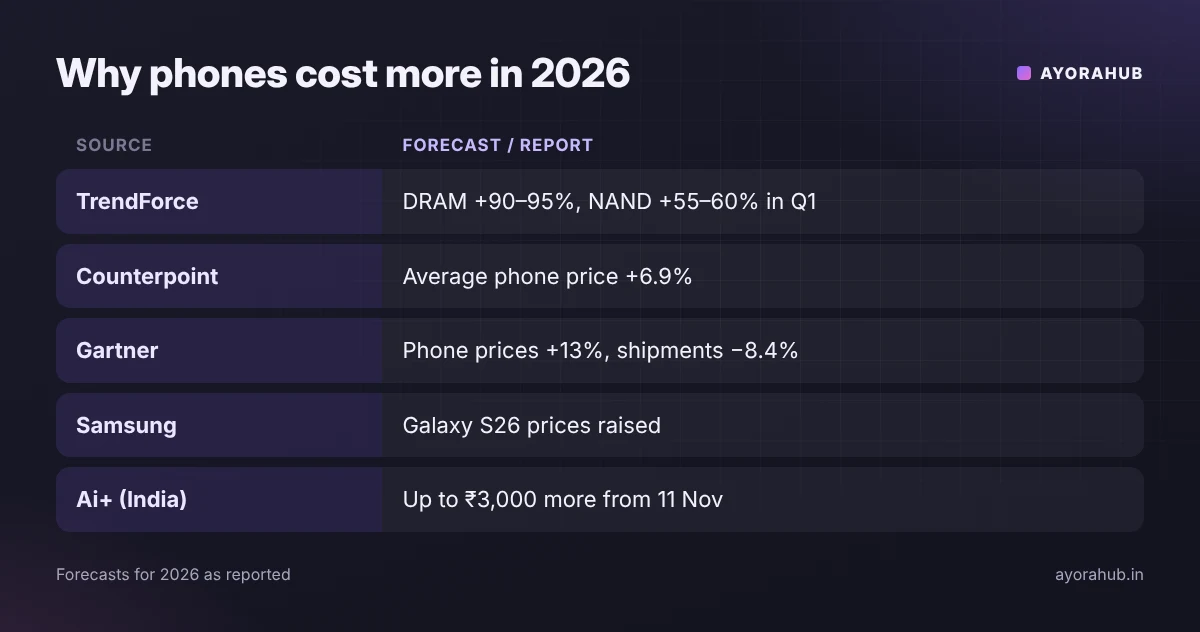
Quick answer (11 November 2026): Phone prices are rising because the memory chips inside them have become much more expensive. AI data centres are buying so much memory that less is left for phones, and research firms report contract prices for DRAM and NAND jumping by 50–95% in a single quarter during 2026. Counterpoint now expects the average smartphone price to rise 6.9% this year; Gartner expects 13% and an 8.4% fall in shipments. The effects are already visible: Samsung raised Galaxy S26 prices, Google launched the Pixel 11 at higher prices, and Indian brand Ai+ raised prices by up to ₹3,000 from 11 November. Winners: memory makers. Losers: budget-phone buyers and smaller brands.
What happened
Every phone needs two kinds of memory: DRAM (the “RAM” that runs apps) and NAND flash (storage). The same factories also make memory for AI servers, which pays far more. As AI spending exploded, chipmakers moved production towards servers, and supply for phones tightened.
| Source | What it reports or forecasts for 2026 |
|---|---|
| TrendForce | DRAM contract prices up 90–95% and NAND up 55–60% in Q1; further large rises in Q2; slower rises (13–18%) reported for Q3 |
| Counterpoint Research | Average smartphone selling price up 6.9% (earlier forecast 3.6%); phone material costs up 8% to over 15% |
| Gartner | Smartphone prices up 13% and PC prices up 17% versus 2025; smartphone shipments down 8.4% |
What is changing for buyers
- Higher launch prices: Google’s Pixel 11 arrived at higher prices in August, with the company pointing partly to memory costs.
- Price rises after launch: Samsung increased Galaxy S26 prices in the US, UK and Europe during 2026.
- Budget brands follow: Ai+ raised prices on selected models in India by up to ₹3,000, bringing the date forward from 15 to 11 November; reports say other Indian brands are also raising prices after Diwali.
- Less memory for the money: some brands keep the price but drop the cheapest storage option, or ship less RAM.

Who gains
- Memory makers — Samsung, SK Hynix and Micron — benefit from higher prices and strong AI demand.
- Brands with scale such as Apple and Samsung, which sign long-term supply deals and can absorb costs better.
- The used and refurbished market, as buyers look for cheaper options.
Who loses
- Budget-phone buyers: Counterpoint expects low-end retail prices to rise by around US$30 — a large share of a cheap phone’s price.
- Small brands with thin margins and less buying power.
- Flagship buyers: analysts expect premium models to cost US$150–200 more.
- The market overall: higher prices mean fewer phones sold.
What you should do
| Your situation | Advice |
|---|---|
| You need a phone soon | Buy during the current sales rather than waiting for prices to fall — analysts do not expect quick relief |
| Your phone works fine | Keep it longer; replace the battery if needed |
| You want value | Consider last year’s flagship or a certified refurbished phone |
| Choosing storage | Buy the storage you need now — upgrades later are impossible, and higher tiers are getting pricier |
Use our Black Friday deals guide to check that a discount is real, and see flagship prices by country.
What to watch next
- Whether memory price rises keep slowing, as Q3 reports suggest.
- Pricing of the Galaxy S27 in early 2027 — see upcoming phones 2027.
- More Indian brands announcing increases.
- New memory factories — but these take years to build.
Tools we recommend · Affiliate links: we may earn a commission if you sign up, at no extra cost to you.


Frequently Asked Questions
Why are phone prices going up in 2026?
Mainly because memory chips cost much more, as AI data centres absorb supply.
How much will phone prices rise?
Forecasts range from about 7% (Counterpoint) to 13% (Gartner) on average for 2026.
Will phone prices come down in 2027?
Analysts do not expect a quick fall; new memory capacity takes years. Price rises may slow.
Which phones have become more expensive?
Examples include the Galaxy S26 series in several regions, the Pixel 11 series at launch and Ai+ models in India.
Should I buy a phone now or wait?
If you need one, buying during a sale now is reasonable. Waiting is unlikely to bring lower prices soon.
The bottom line
The AI boom has an unexpected cost for ordinary buyers: dearer phones. Until memory supply catches up, expect higher launch prices, smaller discounts and fewer cheap models with generous storage. The practical response is simple — buy only when you need to, and keep a good phone a year longer.
More from Tech News
- OpenAI’s Businesses in ChatGPT: who wins and who loses
- Google Assistant is shutting down: what Gemini changes
- Microsoft Publisher has ended: save your .pub files
- WhatsApp usernames: how to reserve yours
How we report tech news
Each AYORAHUB news explainer follows the same structure: what happened, what is being added, what is going away, who gains and who loses, and what you should do. We use company announcements and established publications, name our sources, separate confirmed facts from reports and forecasts, and update the article when the story changes. Last checked: 11 November 2026.