Last updated:
Quick answer (updated November 2026): The iPhone 18 Pro vs Galaxy S26 Ultra vs Pixel 11 Pro choice comes down to chip, camera, AI and price. The iPhone 18 Pro ($1,199 / ₹1,64,900) has Apple’s first 2nm chip, the A20 Pro, and a 48MP camera with a variable aperture. The Galaxy S26 Ultra (US price now about $1,400 / ₹1,39,999) has a 200MP main camera, two telephoto lenses, a 6.9-inch privacy display and the Snapdragon 8 Elite Gen 5. The Pixel 11 Pro ($1,099 / ₹1,19,999) is the cheapest of the three and has the most Google AI, on the Tensor G6. All start at 256GB. Pick the iPhone for performance and video, the Galaxy for zoom and screen, and the Pixel for AI features and value.
These are the three phones most people compare at the top of the market in late 2026. Below are the confirmed specifications, the AI on each, official prices and a simple guide to choosing. We have not tested the phones; this is a specifications-based comparison.
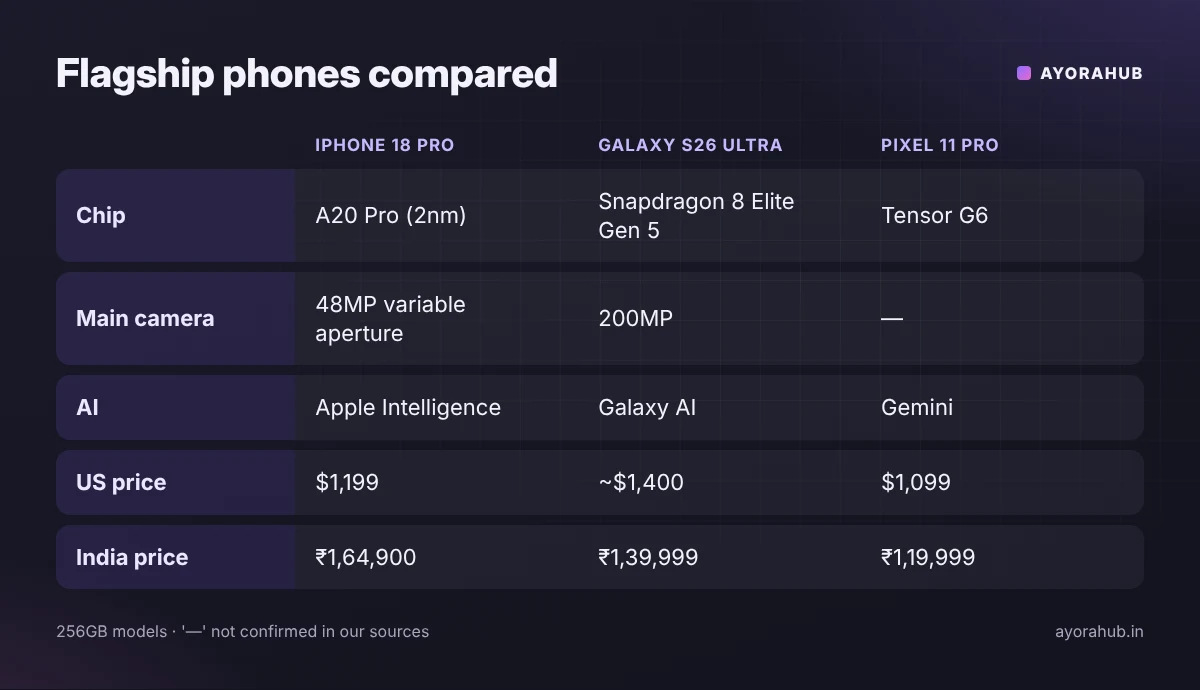
Specifications compared
| iPhone 18 Pro / Pro Max | Galaxy S26 Ultra | Pixel 11 Pro / Pro XL | |
|---|---|---|---|
| Launched | September 2026 | Early 2026 | 12 August 2026 |
| Chip | Apple A20 Pro (2nm) | Snapdragon 8 Elite Gen 5 for Galaxy (3nm) | Google Tensor G6 |
| Display | Pro Max: 6.9-inch OLED, 120Hz | 6.9-inch AMOLED, 120Hz, built-in privacy display | LTPO OLED, 120Hz |
| Main camera | 48MP with variable aperture | 200MP | — (not confirmed in our sources) |
| Other rear cameras | 48MP ultrawide + 48MP telephoto (reported) | 50MP ultrawide; 3× and 5× telephoto | — |
| Front camera | 18MP | 12MP | — |
| Battery | Pro Max: about 5,400mAh (reports vary); up to 45 hours of video (Apple) | 5,000mAh | — |
| Charging | — | Up to 60W wired (sources vary), 25W wireless Qi2.2 | Qi2.2 wireless |
| Base storage | 256GB | 256GB | 256GB |
| AI | Apple Intelligence, Siri AI | Galaxy AI (Gemini, Perplexity) | Gemini, Gemini Nano, Magic Cue |
Swipe to see more →
“—” means we could not confirm the detail from reliable sources. Check the maker’s website before buying.
Performance
Apple’s A20 Pro is its first chip made on a 2-nanometre process; Apple says its 7-core GPU is up to 40% faster than the A19 Pro’s. The Galaxy’s Snapdragon 8 Elite Gen 5 is Qualcomm’s top Android chip, tuned for Samsung. Google’s Tensor G6 is designed around AI rather than raw speed — Google highlighted a 50% boost to the part of the chip that runs on-device AI. Google’s hardware chief said it uses an enhanced 3nm process, despite earlier 2nm rumours.
In practice: all three are fast for everyday use. Heavy gamers and video editors will get the most headroom from the iPhone and the Galaxy.
Cameras
- iPhone 18 Pro: a 48MP main camera with a variable aperture — the lens opening changes to control light and background blur — plus Apple’s strong video.
- Galaxy S26 Ultra: the most versatile hardware: a 200MP main sensor, a 50MP ultrawide and two telephoto cameras (3× and 5×) for zoom.
- Pixel 11 Pro: Google’s strength is software — Camera Coach, Add Me, Magic Capture and new “Camera Looks”.

AI features
| Phone | Best AI trick | Watch out for |
|---|---|---|
| iPhone 18 Pro | Siri AI with personal context and on-screen awareness; private processing | Siri AI is a beta, English first |
| Galaxy S26 Ultra | Now Nudge, call screening, choice of Gemini or Perplexity | Features vary by region |
| Pixel 11 Pro | Magic Cue and Gemini Live, running on Gemini Nano | Best if you use Google’s apps |
Full comparison: Apple Intelligence vs Galaxy AI vs Gemini.
Prices (256GB)
| Phone | USA | UK | India |
|---|---|---|---|
| iPhone 18 Pro | $1,199 | £1,199 | ₹1,64,900 |
| iPhone 18 Pro Max | $1,299 | £1,299 | ₹1,79,900 (as reported) |
| Galaxy S26 Ultra | $1,299 at launch; about $1,400 after an October 2026 increase | £1,279 at launch; £1,360 reported after increase | ₹1,39,999 |
| Pixel 11 Pro | $1,099 | £1,079 | ₹1,19,999 |
| Pixel 11 Pro XL | $1,299 | £1,279 (as reported) | ₹1,34,999 |
Swipe to see more →
More storage tiers and why prices differ: flagship phone prices by country.
Which one should you buy?
| You want… | Choose |
|---|---|
| The fastest chip and best video; you use a Mac, iPad or Apple Watch | iPhone 18 Pro |
| The best zoom and the largest, most private screen | Galaxy S26 Ultra |
| The most helpful AI at the lowest price of the three | Pixel 11 Pro |
| To spend less | Last year’s models, or wait for sales — see our Black Friday guide |
| The newest Samsung | Wait: the Galaxy S27 series is expected in early 2027 |
Common mistakes
- Comparing megapixels only — sensor size, lenses and software matter as much.
- Ignoring the ecosystem — switching between iPhone and Android means moving apps, accessories and habits.
- Buying the Galaxy weeks before its successor — prices of the old model usually fall after a launch.
- Forgetting local warranty and service when importing a cheaper unit.
Tools we recommend · Affiliate links: we may earn a commission if you sign up, at no extra cost to you.

Frequently Asked Questions
Which is better: iPhone 18 Pro or Galaxy S26 Ultra?
The iPhone leads on chip and video; the Galaxy leads on zoom cameras and display. Choose by ecosystem and what you photograph.
Is the Pixel 11 Pro cheaper than the iPhone 18 Pro?
Yes: $1,099 vs $1,199 in the US, and ₹1,19,999 vs ₹1,64,900 in India for 256GB.
Which phone has the best camera?
The Galaxy S26 Ultra has the most versatile hardware (200MP, two telephotos); the iPhone is strongest for video; the Pixel relies on AI processing.
What chip does the iPhone 18 Pro use?
The A20 Pro, Apple’s first 2-nanometre chip.
Does the Galaxy S26 Ultra have a privacy display?
Yes, reviews list a built-in privacy display feature on its 6.9-inch screen.
Should I wait for the Galaxy S27?
If you want the newest Samsung and can wait until early 2027, yes. Otherwise the S26 Ultra may get cheaper as the S27 approaches.
Conclusion
There is no wrong choice among these three — only a wrong fit. Choose the iPhone 18 Pro for performance and the Apple ecosystem, the Galaxy S26 Ultra for cameras and display, and the Pixel 11 Pro for AI and value, then check your local price and offers. Start with our overview: which AI is in your phone?
How we researched this
We used manufacturers’ software pages, launch coverage and specification databases from established technology publications, checked in November 2026. Prices are official launch or list prices as reported and can change; features vary by model, region and language. We have not tested these phones. Where a detail could not be confirmed we say so rather than guess.