


Last updated:
Quick answer (updated 13 November 2026): SpaceX Starship is a giant, fully reusable rocket and the largest ever flown. It has two stages: the Super Heavy booster and the Starship upper stage (“Ship”), both powered by methane-fuelled Raptor engines. Its milestones so far:
- Flight 12 (22 May 2026) was the first flight of the bigger V3 version.
- Flight 14 (28 September 2026) reached orbit and deployed Starship’s first operational payload.
- Flight 15 is scheduled for 13 November 2026 and aims for the first-ever double catch: booster and ship caught by the launch tower’s “chopstick” arms.
Starship is central to Elon Musk’s biggest goals: cheap launches for the next generation of Starlink, NASA’s Artemis Moon landings and, eventually, Mars. Here is how it works and where it stands.
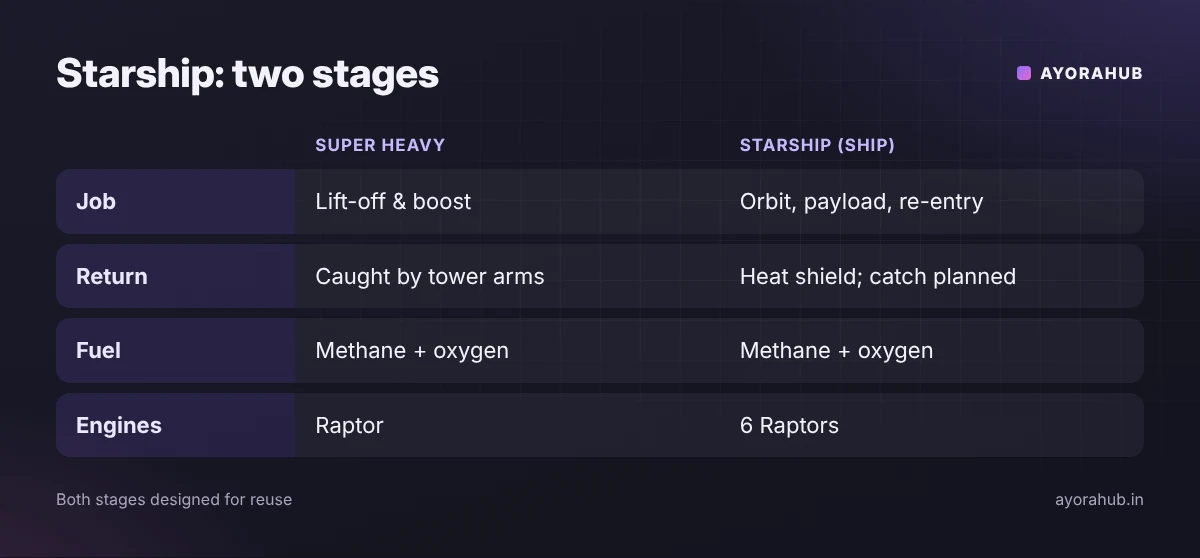
Starship explained: the two stages
| Super Heavy (booster) | Starship (Ship) | |
|---|---|---|
| Job | Lifts the rocket off the pad and out of the thick atmosphere | Carries payload or crew to orbit and beyond, then re-enters |
| Engines | Many Raptor engines | Six Raptors (sea-level and vacuum versions) |
| Return | Flies back and is caught by the launch tower arms | Re-enters behind a heat shield of thousands of tiles; tower catch is the goal |
| Fuel | Liquid methane and liquid oxygen | |
Why Starship matters
- Full reusability: Falcon 9 reuses its first stage; Starship aims to reuse both stages, like an aircraft. That could cut the cost per launch dramatically.
- Payload: it is designed to carry far more to orbit than any rocket flying today.
- Starlink V3: the larger next-generation Starlink satellites need Starship. The first ones reached orbit in September 2026, according to trackers.
- Moon (Artemis): NASA chose a version of Starship as the lander to bring astronauts to the Moon’s surface. This needs in-orbit refuelling, which still has to be demonstrated.
- Mars: Musk’s long-term goal is uncrewed and then crewed flights to Mars. No date is confirmed.
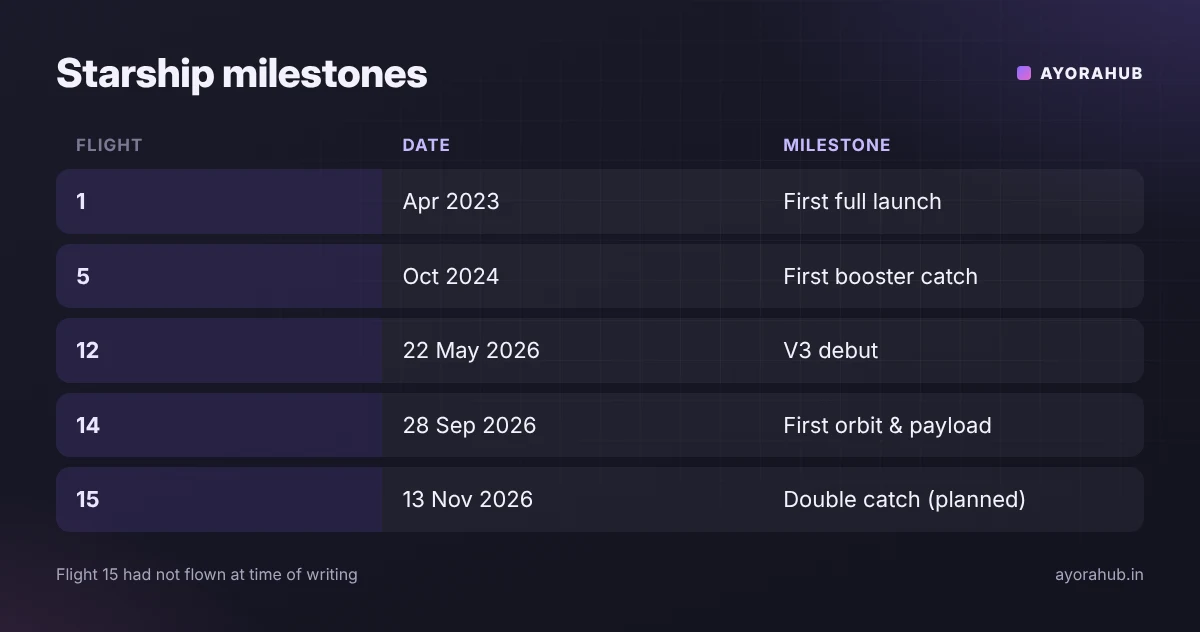
Starship test flights: key milestones
| Flight | Date | What happened |
|---|---|---|
| Flight 1 | April 2023 | First full launch; vehicle lost a few minutes into flight |
| Flight 5 | October 2024 | First booster caught by the tower’s chopstick arms |
| Flight 12 | 22 May 2026 | First V3 flight from the new Pad 2. The Ship reached space, deployed 22 Starlink simulators and splashed down on target in the Indian Ocean. An engine shut down early, a planned engine relight was missed, and the booster was lost. |
| Flight 14 | 28 September 2026 | First orbital flight; deployed Starship’s first operational payload |
| Flight 15 | 13 November 2026 (scheduled) | Planned double catch of booster and ship |
After Flight 12, the US Federal Aviation Administration (FAA) reviewed the booster anomaly before further flights, as it does after most mishaps.
Challenges still ahead
- Heat shield: it must survive re-entry with little or no repair between flights.
- Ship catch: catching the upper stage has never been done before Flight 15’s attempt.
- Refuelling in orbit: transferring large amounts of propellant between two Starships is needed for Moon and Mars missions.
- Regulation and environment: each mishap triggers reviews, and launch rates depend on licences.
What Starship means for everyday users
Cheaper, larger launches let SpaceX deploy the bigger V3 Starlink satellites, which could mean faster and cheaper satellite internet worldwide. See Starlink price and availability by country. Other companies and agencies, from Blue Origin to ISRO and Chinese launch firms, are developing their own reusable rockets.
Tools we recommend · Affiliate links: we may earn a commission if you sign up, at no extra cost to you.


Frequently Asked Questions
What is SpaceX Starship?
A two-stage, fully reusable super-heavy rocket. The Super Heavy booster and the Starship upper stage are both designed to return and fly again.
Has Starship reached orbit?
Yes. Flight 14 on 28 September 2026 was its first orbital flight and deployed its first operational payload.
What is Starship V3?
The third, larger version of Starship and Super Heavy, which first flew on Flight 12 on 22 May 2026.
What is the Starship double catch?
Catching both the booster and the ship with the launch tower’s arms after one flight. SpaceX planned to try it on Flight 15, scheduled for 13 November 2026.
When will Starship go to Mars?
No date is confirmed. Musk has given targets before that slipped. Orbital refuelling must work first.
Is Starship bigger than the Saturn V?
Yes. Starship is taller and more powerful than NASA’s Saturn V Moon rocket, making it the largest rocket ever flown.
Conclusion
In 2026 Starship moved from dramatic tests to real missions: the V3 debut, the first orbital flight and a payload deployment. The next big tests are catching the ship and refuelling in orbit. We will update this page with the Flight 15 result. For all of Musk’s companies, see Elon Musk companies and technologies explained.
How we researched this
We used CNN’s Flight 12 coverage, Wikipedia’s tracked flight pages, Space.com, ABC News and The Week on Flight 15, checked on 13 November 2026. Flight 15 had not flown at the time of writing.



3 comments